
By: Michala Sawyer

Almost everyone has heard the name “chlamydia” before, whether from a high school sexual education class, social media, or from that one line in the 2004 cult classic Mean Girls — “but if you do touch each other, you will get chlamydia, and die.” Now, the odds of someone dying from a preventable and curable infection like chlamydia are very slim, but that does not mean people should not be cautious during sexual encounters. However, hearing the name and understanding the bacteria responsible for the infection are two very different (microscopic) beasts.

On a macroscopic level, chlamydia is the most commonly reported sexually transmitted infection in the United States. In fact, the CDC reported that 1.5 million new cases of chlamydia were diagnosed in 2015 alone. However, the CDC estimates the true number of annual cases to be much higher, almost 3 million in fact. The population at the highest risk of contracting chlamydia are people aged 14-24, as around 60 percent of new diagnoses occur within that age group. Transmission of chlamydia occurs via anal, vaginal and oral sex with an infected partner. It is also possible and common for an infected mother to transmit chlamydia to their baby during labor and delivery.
Most people with chlamydia do not show symptoms, meaning that many people infected don’t know they have it, and even if you are asymptomatic, the infection could still potentially damage your reproductive system. For a biologically female individual, the infection can spread to their fallopian tubes and uterus, leading to pelvic inflammatory disease, which is known to cause infertility.
A lot of people think “STI” when asked about chlamydia, but that is not all the bacterium can cause. Ever heard of trachoma? It is the world’s leading cause of infectious blindness. You can contract this infection without sexual contact specifically. You can get if from mere personal contact with an infected individual (either direct or via cloth such as bedding, clothes or towels) and from flies that have been in contact with the bodily fluids of an infected individual. Usually, an individual’s immune system is strong enough to combat the initial infection. However, in endemic communities, repeated infection can lead to severe scarring of the eyelid and the cornea. Treatment with the antibiotic penicillin for both kinds of infection have not been successful, however, both types are effectively treated with tetracycline, rifampin and erythromycin.
 |
| Figure 1. Phase contrast L2 mouse fibroblast cells infected with C. trachomatis 6 hours post infection |
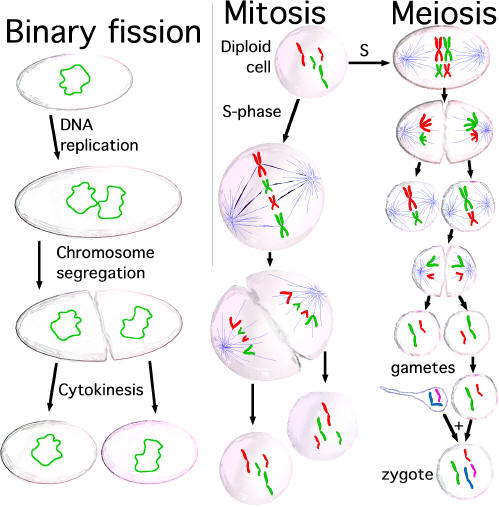
On a microscopic level, the mighty microbe behind the infection is Chlamydia trachomatis. They are coccoid, intracellular, obligate, gram-negative bacteria, which rely on their host cell’s metabolic intermediates due to lacking many of their own intrinsic metabolic pathways (See Fig.1 above). For example, C. trachomatis cannot make their own ATP and must use ATP from their host cell. An interesting thing about C. trachomatis is that they can exist in two very different states: infectious elementary bodies and intracytoplasmic reticular bodies. When outside a host cell, the elementary body, which is no bigger than 0.3 microns, is metabolically inert. Upon host cell infection, the bacteria double in size and transitions into the reticular body, which is metabolically active and can replicate via binary fission (See diagram of binary fission vs mitosis & meiosis here).
Because C. trachomatis undergoes this transformation from elementary body to reticular body, there has been serious debate over what has been named the “chlamydial anomaly.” Most bacteria contain a structure called a “cell wall.” It is made up of a mesh-like sheet of the sugar amino acid polymer, peptidoglycan (PG), which surrounds the plasma membrane of a bacterium. The cell wall aids in many processes throughout the bacterial life cycle, such as cell division, maintaining cell shape via turgor pressure and act as anchor for transmembrane complexes and proteins.
 |
| Figure 2. The biosynthesis of the terminal PG stem of a gram-negative bacteria. |
A single unit of PG is made up of a disaccharide backbone connected to a pentapeptide chain, which contains two amino acids unique to bacteria, D-alanine and D-glutamate (Fig. 2). The enzymes responsible for the synthesis of those two amino acids, as well as the enzymes involved in their PG incorporation, since they are not present in mammals, are classic targets for antibiotics.
Until recently, no one knew whether C. trachomatis actually possessed PG. A paradox existed surrounding this question, for both genetic analysis and antibiotic susceptibility gave credence to the claim that C. trachomatis had PG, but all attempts to detect said PG in the lab had been previously unsuccessful. Infections from C. trachomatis cannot to be treated by penicillin (See penicillin mechanism of action in bacteria here), which is interesting because acts by blocking the biosynthesis of PG. This was previously known in microbiology as the “chlamydial anomaly.”
 |
| Figure 3. The chemical structures of D-Ala and it’s alkyne- and azide dipeptide analog probes used in this study. Abbreviation:DA-DA (D-alanyl-D-Alanine), EDA (ethynyl-D-alanine), ADA (azido-D-alanine), EDA-DA (ethynyl-D-alanyl-D-alanine) and ADA-DA (azido-D-alanyl-D- alanine). |
In a study published in Nature in 2014, Liechti et al. were able to detect PG within C. trachomatis for the first time using a modified dipeptide probe, which was incorporated into the PG cell wall (Fig. 3). This new method of cell wall labeling was discovered when they modified the probe via utilization of click chemistry by creating alkyne- and azide- analogs of the D-alanine amino acid and were able to incorporate it into the PG (Fig. 3). The authors were able to see the labeled PG as early as 8 hours after infection, which suggests that the probe is incorporated and new PG is synthesized after the transition from elemental body to reticular body has begun.
However, while PG detection has been successful, they were only able to detect it at the septum of cell division, which suggests that new PG biosynthesis occurs only at that point. Despite this advance, future studies are needed to confirm whether the PG is present only at the septum or if it’s only newly synthesized PG that is present there and if so, is there a mechanism limiting its diffusion throughout the rest of the cell wall. As of right now, there are antibiotics that can treat chlamydial infections, but we do not know the mechanism behind the susceptibility of C. trachomatis to these antibiotics. Further research into the role of PG in cell division could shed light on these mechanisms and provide possible new drug targets specific to chlamydial infections. Since chlamydia is so prevalent among young people in the U.S., developing new drugs can help combat the epidemic, in addition to proper sexual education about the health risks of “taking off your clothes and touching each other.” In the meantime, “everybody take some rubbers.”

~~
 |
| Meet the author: Michala Sawyer |
Michala is a senior at Mount Holyoke College. She will graduate in May, 2017 with a bachelor’s degree in biology and a minor in chemistry. She enjoys learning about reproductive health and biology, and will be applying to graduate programs in the fall that focus on biomedical sciences before eventually going on to medical school to be an OB/GYN. While at Mount Holyoke, Michala has enjoyed her extracurricular work as a Features editor for the Mount Holyoke News, a volunteer EMT for the campus Medical Emergency Response Team, and her job as an EMT/Athletic Training Aid for the Athletic Training Room. When she has time outside of her work and studies, Michala loves to read sci-fi/fantasy and horror novels and bake delicious cakes and other desserts.

No comments:
Post a Comment