
Most of the time, we think of microbes as just tiny living things stuck to a surface or floating around in a liquid. Some cells have the capability to swim, inch across a surface, or push against other cells and their environment to move around. Cell motility is essential for bacterial survival because it is a form of offering protection, detecting a favorable condition of the habitat, and allowing cells to sequester resources in the most efficient way. Understanding the role of motility is crucial for determining the behavior, virulence, and colonization of a bacterial species. The methods already mentioned are the most common ways that microbes have figured out how to move around, but one normally non-motile microbe, Staphylococcus aureus, has been discovered to perform one of the more unusual methods of moving around.
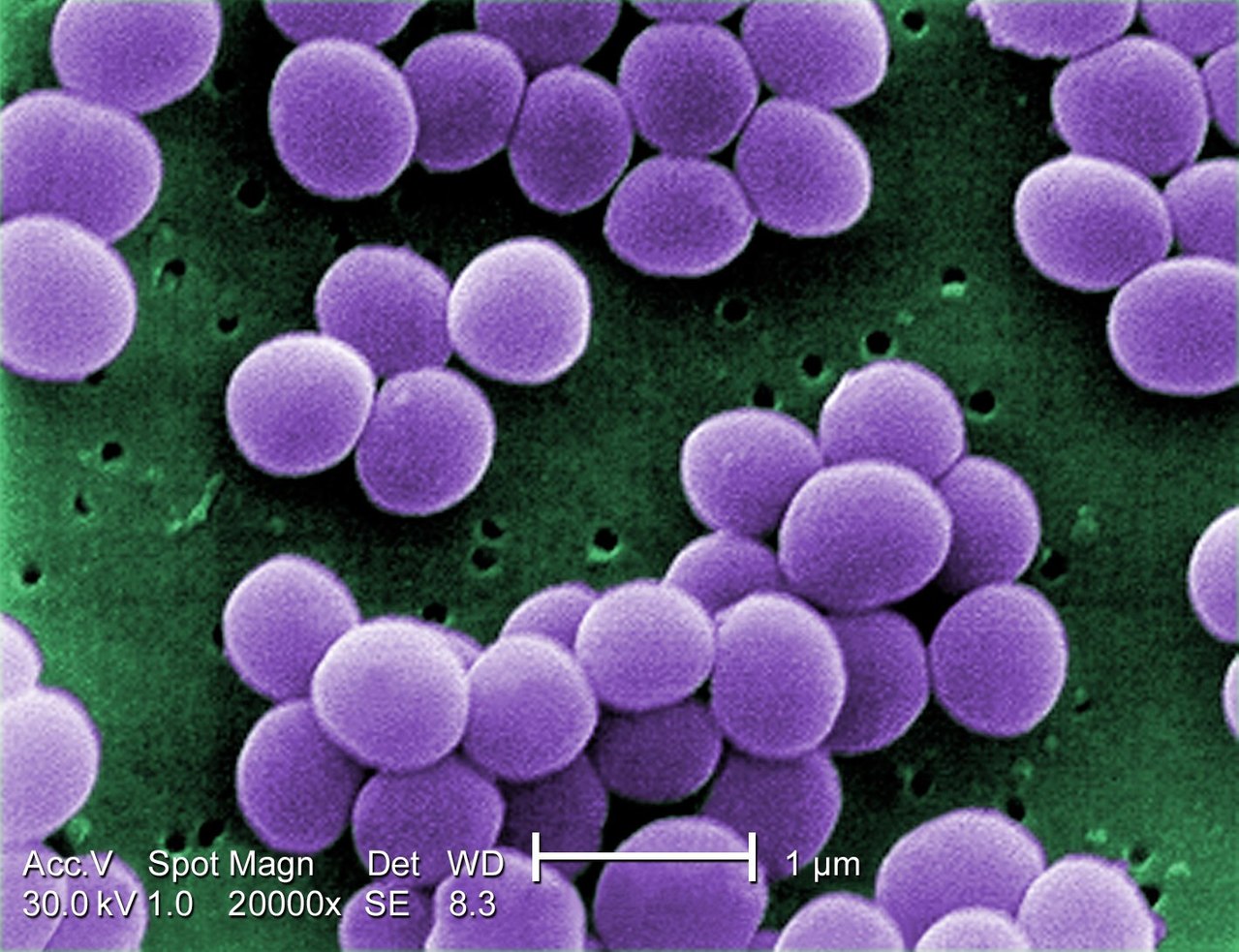
Staphylococcus aureus. Source
You perhaps have heard of S. aureus by one of its nicknames, Staph. It is a normal part of the human microbiome, but it occasionally becomes pathogenic, causing as minor a problem as pimples to something as serious as Pneumonia, Toxic Shock Syndrome, and Sepsis in medical environments. It has also developed antibiotic resistant strains against methicillin and vancomycin, two very common antibiotics. You may have heard of the former by its initialism MRSA, Methicillin Resistant Staphylococcus aureus, which is a scourge of hospitals. This bacteria is of import to humans, and has been extensively studied, but an approved vaccine to prevent the more harmful effects has never been developed. S. aureus is widely available for study so that new weaknesses can be discovered in its biology and chemistry that could be exploited in future development of treatments such as a vaccine for this common pathogen.
Historically, Staphylococcus aureus is regarded as a non-motile organism, due to the lack of motility mechanisms such as a flagellum. Normally, S. aureus uses a passive form of movement to spread across a surface, which is moving by virtue of the fact that there isn’t enough space for all the cells and they get shoved out of the way to make room for new ones. However, we are here to tell you about a recent study by Pollitt, Crusz, and Diggle in 2015, that reveals a previously undescribed form of active motility in S. aureus. The paper focuses on the comet, a structure named by the study, consisting of a cluster of exploratory cells (referred to as a core) extending outward from the center of the colony and seeding cells behind forming a comet tail, thus enabling the microbe to advance across the surface of agar media and preceding the formation of observable dendrites. The presence of the “comet” structure contradicts the idea of S. aureus as a non-motile organism, or one that uses a passive form of motility. Gliding is the least understood form of motility, defined as either individual or social cell movement on a surface with no apparent external structures. One hypothesis for the mechanism of gliding is focal adhesions within the outer membrane of a cell that attach to the external surface and push the cell along in a way that is not visible from the exterior and so difficult to study.
Pollitt, Crusz, and Diggle first investigated dendrites formation, which are branches that emerge from the central colony. It appears that dendrites occurred in most strains, but not all. They conclude that the finger-like dendrites are formed as a behavior that is maintained in different S. aureus strains. However, their function(s) is not mentioned in the study. They then present the phase-contrast microscopy images showing these dendrites are preceded by the comet structures, which are the main source of movement as shown in Figure 1. Under 400x magnification, the comet heads are composed of aggregate S. aureus cells encased in a slime matrix, which the study defined as a disorganized matrix of extracellular material, and display no observable flagella-like structure. Under certain conditions, S. aureus comets etch their movement on the agar, leaving behind physical tracks. The study suggests that comet movement relies on surfactant production. Each S. aureus colony appears to be surrounded by a surfactant halo that has a varied diameter, centered on the comet. It was observed that comets from different colonies would avoid each other, clearing a path for movement not only of debris but also other individuals.

Figure 1. Comet structures and dendrites were observed using phase contrast microscopy. A) Comet structure of S. aureus cells in the Newman laboratory strain, indicated with an arrow, formed at the tip of the dendrites. B) After hours of incubation, the comet extended outward and seeded cells behind formed a tail. Dendrites were preceded by the comets in all the strains that produced dendrites. Only RN630B, the standard laboratory wild-type strain, did not produce a comet nor was it observed to produce dendrites. C) Phase contrast microscopy of a comet shows they are composed of a grouping of cells.
Based on these results, S. aureus seems to engage in activities that resemble gliding motility, which is theorized to be powered by a wide range of possible mechanisms, including focal adhesion, slime extrusion complexes, and others. This mechanism needs further research to determine the mechanics of the motility, and this research has perhaps not solved, but at least given a new example of gliding motility to the scientific community that can be used to further research on this uncommon method. Recognizing the specific motility of a microorganism can point us to the ways that it initiates movement and spreads. Currently, there is no vaccine to prevent S. aureus infection. There have been multiple attempts over the years to create vaccines that have even made it to clinical trials. Several different approaches showed excellent promise in rodent models that did not transfer to human trials. Applying this understanding to continue research on these pathogenic bacteria that use motility in a later stage of infection, we might be able to develop better therapeutic methods and possibly even a vaccine for S. aureus and others that work like it.
About the authors:
Coming soon!

No comments:
Post a Comment